Swiss rental guide
Documents for a Swiss rental application
Learn which documents landlords and agencies in Switzerland usually expect, which ones are mandatory, and how to organise them into a complete rental dossier that looks reliable from the first page.
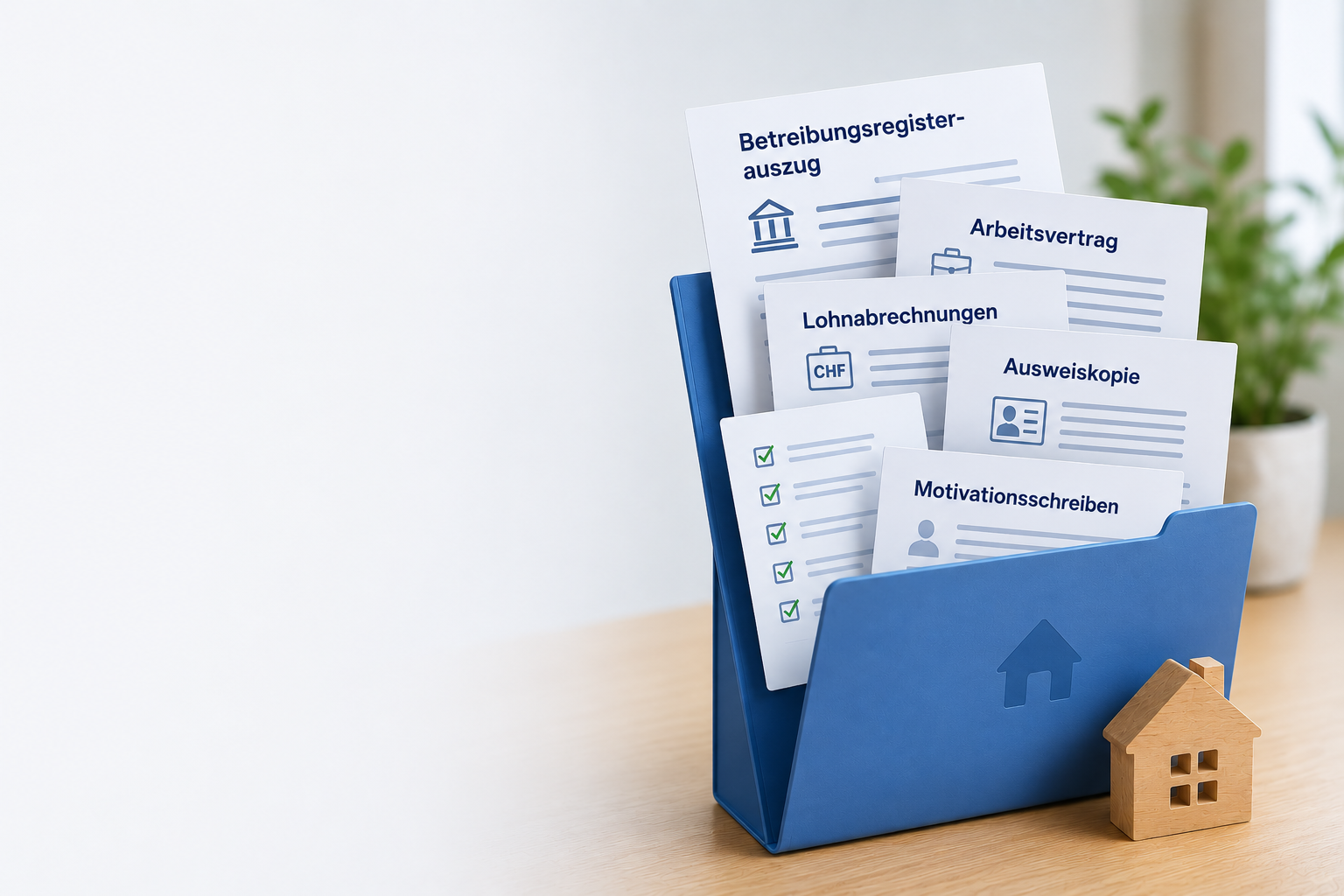
Which documents should be included in a Swiss rental application?
Swiss landlords do not always ask for the exact same file, but they usually want a clear picture of your identity, income, payment reliability, and overall seriousness as an applicant.
Application form
Usually supplied by the landlord or agency. It is the administrative basis of the application and should match the details shown in the rest of your dossier.
Debt register extract
A debt register extract is one of the most commonly requested documents in a Swiss rental application. It shows whether debt enforcement proceedings have been registered against you in the relevant district, and many landlords prefer an extract issued within the previous three months.
- What it is: an official extract from the local debt enforcement office.
- Why landlords ask for it: it helps assess payment reliability and follow-up risk.
- How recent it should be: many agencies prefer a document issued within the last 3 months.
- Where to obtain it: from the debt enforcement office responsible for your current or recent place of residence.
- If entries appear: add short factual context and proof of settlement if available.
- Foreign applicants: if there is no Swiss history yet, provide the strongest alternative proof and explain the relocation context.
- Before submitting: check the issue date, scan every page, keep official stamps visible, and make sure your name and address are readable.
Employment contract
An employment contract helps agencies understand whether your income is stable and how secure the employment relationship appears. It is especially useful when you have recently changed jobs or started a new position in Switzerland.
- What it is: a signed contract or employer confirmation showing role, salary basis, and contract type.
- Why landlords ask for it: it supports the salary documents and clarifies job stability.
- When it matters most: especially useful for recent employment, probation periods, or new arrivals.
- What it should show: employer name, start date, salary basis, and contract duration if limited.
- If you do not have the final contract yet: use the strongest equivalent, such as a signed offer or employer letter.
- Common mistakes: sending an unsigned draft or a version with missing salary details.
- Before submitting: make sure the important pages are included and the salary terms are readable.
Payslips
Payslips are one of the core income documents in a Swiss rental application. They show how much you actually earn, whether the income is regular, and whether the rent looks affordable compared with your monthly salary.
- What they are: official salary statements from your employer.
- Why landlords ask for them: they help assess affordability and income stability.
- How many to include: often the latest 3 payslips unless the agency asks for something else.
- What they contain: employer details, gross and net salary, deductions, and payment dates.
- If income varies: add the most representative recent slips and include short context if needed.
- Common mistakes: missing pages, unreadable numbers, or slips that do not match the applicant name.
- Before submitting: include the latest slips, scan them clearly, and keep all totals readable.
ID or passport copy
A clear copy of your passport or national ID helps the landlord confirm who is applying and match the identity details across the rest of the dossier. It is one of the most standard documents in Swiss rental applications.
- What it is: a readable copy of your passport or official identity card.
- Why landlords ask for it: to verify identity and connect the application to the right person.
- What it should show: full name, date of birth, document number, and photo page where relevant.
- For multi-person households: include identification for each adult applicant if required.
- Common mistakes: cropped edges, unreadable numbers, or scans with glare over key details.
- Privacy note: redact cautiously only if the document remains clearly identifiable.
- Before submitting: check that the full page is visible and all identity details are legible.
Residence permit
For non-Swiss applicants, the residence permit is often an important supporting document. It helps the agency understand your legal status in Switzerland and whether you are already established locally or still relocating.
- What it is: a copy of your Swiss residence permit, such as B, C, L, or G, when applicable.
- Why landlords ask for it: to understand residency status and practical tenancy context.
- Who should include it: non-Swiss applicants or cross-border applicants when relevant.
- What it should show: permit type, validity, and the applicant identity details.
- If the permit is pending: add the strongest official confirmation available and explain the status briefly.
- Common mistakes: sending an expired permit or omitting the reverse side if important information appears there.
- Before submitting: include a clear copy and check that permit type and expiry date can be read easily.
Motivation letter
A motivation letter is usually optional, but it can help when several applicants look similar on paper. It gives you a short space to explain your move, household, reliability, and why the property is a good fit.
- What it is: a short letter that adds context to the supporting documents.
- Why landlords ask for it: not always required, but useful when they compare similar applicants.
- What to include: household situation, move reason, stability, and a concise, credible tone.
- When it helps most: competitive markets, unusual profiles, or relocations that need explanation.
- What to avoid: long personal stories, emotional claims, or details that do not help the decision.
- Common mistakes: repeating the whole CV instead of adding focused context.
- Before submitting: keep it short, factual, and aligned with the rest of the dossier.
References
References can strengthen trust when the landlord wants reassurance beyond the core documents. They are particularly useful if your profile is unconventional, your Swiss history is short, or several applicants appear similarly strong.
- What they are: contact details or written references from previous landlords, employers, or relocation contacts.
- Why landlords ask for them: they add external credibility when documents alone do not tell the full story.
- Who should provide them: applicants with limited Swiss history, recent moves, or profiles that need extra trust signals.
- What good references contain: the relationship, a short reliability statement, and current contact details.
- When they are less useful: if the contacts are outdated or cannot realistically respond.
- Common mistakes: listing references without permission or without explaining who they are.
- Before submitting: check names, phone numbers, and whether the reference expects to be contacted.
Pet documents
Helpful if you have a dog or cat and want to address likely landlord concerns early with clear, practical information.
Income proof for self-employed applicants
Self-employed applicants usually need to replace standard payslips with a broader set of financial evidence. The goal is to show that income is real, recurring, and strong enough for the rent level in question.
- What it is: tax returns, annual accounts, accountant letters, business income summaries, or similar financial proof.
- Why landlords ask for it: there are no standard payslips, so stability must be shown differently.
- What to include: the clearest documents that show recurring income, business activity, and overall credibility.
- How much is enough: enough evidence to make the income level understandable without overloading the file.
- If income fluctuates: add a short explanation so unusual months do not create confusion.
- Common mistakes: sending raw business exports with no context or documents that are too old to be useful.
- Before submitting: choose the strongest recent records and make sure the key figures are easy to find.
Liability insurance
Not always required at application stage, but sometimes appreciated as a practical extra that signals organisation and readiness.
You do not need to send every possible document in every case. The goal is to submit a complete, relevant, readable dossier without obvious gaps.
If you need more detail before you assemble the file, see how to obtain a Swiss debt register extract, write a rental motivation letter, or download the rental application checklist.
Have your documents ready?
Combine them into one professional Swiss rental dossier.
Start the dossier generatorWhich documents are usually required and which are mainly recommended?
Requirements vary by landlord, agency, canton, and applicant profile. This overview helps you distinguish between documents that are commonly expected and documents that mainly strengthen the dossier.
| Document | Typical status | Notes |
|---|---|---|
| Application form | Usually required | Provided by landlord or agency |
| ID or passport | Usually required | Required for identity verification |
| Debt register extract | Usually required | Commonly requested, preferably under 3 months |
| Payslips | Usually required | Often the latest three |
| Employment contract | Sometimes required | Especially useful for recent employment |
| Residence permit | Required when applicable | For non-Swiss applicants |
| Motivation letter | Optional but recommended | Helps differentiate similar applicants |
| References | Optional but recommended | Depends on agency and applicant profile |
| Liability insurance | Optional | Occasionally requested |
| Pet documents | Required when applicable | Relevant where pets are involved |
Checklist before sending your rental application
Review each point before submitting the dossier. A complete and well-ordered file is easier to assess and reduces avoidable back-and-forth with landlords or agencies.
How to make the dossier look stronger
In competitive Swiss rental markets, presentation matters almost as much as content. These small steps improve readability, trust, and overall first impression.
- Use recent, readable documents only
- Combine everything into one structured PDF
- Keep document names and order consistent
- Add a short motivation letter when useful
- Remove unnecessary clutter and duplicate files
- Check that every page is complete and legible
How to prepare your rental application documents
A complete Swiss rental dossier is easier to build when you follow a clear order. This workflow helps you move from missing paperwork to one final file that is ready to submit.
- 1Check the agency requirements
- 2Request your debt register extract
- 3Collect income and employment evidence
- 4Scan identity and permit documents
- 5Add supporting documents
- 6Review dates and readability
- 7Arrange documents in a logical order
- 8Merge everything into one PDF
- 9Compress the file if necessary
- 10Submit and keep a copy
Before you submit, you can also create a professional rental dossier, check whether your rent is affordable, and evaluate your rental dossier score.
Visual examples of good rental application documents
These mock examples show what well-prepared rental documents usually look like and where weak presentation often creates avoidable friction.
Anonymized debt register extract
Use a recent official extract with all pages visible, readable details, and official stamps left intact.
Example payslip
A good payslip example keeps employer name, salary figures, dates, and key totals easy to verify at a glance.
Passport scan: good vs bad
Identity documents should be straight, complete, readable, and free from glare, blur, and cropped edges.
Residence permit example
Permit copies should show permit type, expiry date, and all relevant sides when information appears on both.
Example PDF cover page
A simple cover page helps the landlord identify the applicant, property reference, and file contents immediately.
Correct document order
A logical order makes the dossier faster to review and reduces the chance that a strong document gets missed.
One PDF vs many attachments
One organised PDF usually looks more professional than many separate files arriving without a clear sequence.
Timeline of document preparation
Preparing the file step by step helps you request slow documents early and avoid last-minute gaps.
Good scan vs poor scan
| Good | Poor |
|---|---|
| Straight page | Cropped page |
| Readable text | Blurred text |
| Full official stamp | Missing edges |
| Consistent orientation | Rotated pages |
| Reasonable file size | Oversized image |
Suggested order for a Swiss rental application PDF
If you merge all documents into one PDF, the order matters. A clean sequence helps landlords review the file faster and understand your profile without searching through attachments.
- 1Cover page
- 2Application form
- 3Short applicant profile
- 4Motivation letter
- 5Passport or ID
- 6Residence permit
- 7Employment contract
- 8Latest three payslips
- 9Debt register extract
- 10References
- 11Additional supporting documents
What personal data can you redact?
You can hide some sensitive details in a rental application, but only where those details are not necessary for the landlord or agency to verify identity, income, or the authenticity of the document.
- Bank account numbers can usually be partially redacted when they are not needed for the rental decision.
- Social insurance numbers and similar personal identification numbers should usually be hidden unless a specific legal or administrative reason requires them.
- Medical information should generally be removed because it is not relevant to the rental decision.
- Irrelevant transactions on bank or account documents can usually be redacted if the remaining content still proves the income or balance that matters.
- Sensitive data about family members should be limited to what is genuinely necessary for the application.
Redact only information that is not relevant to the rental decision. Do not hide the applicant’s name, employer, income amount, document date, or official confirmation details when these are necessary for verification.
Requirements vary by landlord and agency. Applicants should provide only the information reasonably necessary for the rental application.
Avoid these common mistakes
Using an outdated debt extract
Landlords often expect a recent extract, and an older one makes the application look stale.
- Problem: it can trigger questions about your current payment situation.
- Fix: order a new extract, ideally issued within the last 3 months.
- Example: a clean extract from 8 months ago still looks weaker than a recent one.
Missing pages
A partial document makes the dossier look careless and incomplete.
- Problem: key salary, permit, or form details may be missing.
- Fix: check every PDF page before merging the final file.
- Example: only page 1 of a two-page permit copy is attached.
Cropped official stamps
Cutting off stamps or margins can make official records look unreliable.
- Problem: the document may no longer look fully authentic.
- Fix: scan the full page with all edges and official markings visible.
- Example: the debt extract stamp is half cut off at the bottom.
Blurred phone photographs
Quick phone photos often look informal and are hard to read.
- Problem: landlords may not wait for clearer replacements.
- Fix: use a scanner or high-quality flat photo in good light.
- Example: the passport number is blurred because the image was taken by hand.
Password-protected PDF files
Protected files slow review and can block access completely.
- Problem: agencies cannot open the dossier immediately.
- Fix: remove passwords before sending unless a secure channel was explicitly requested.
- Example: the PDF opens only after entering a password that was never shared.
Incorrect applicant name
Name inconsistencies create avoidable trust issues.
- Problem: the agency may not know whether documents belong to the same person.
- Fix: check spelling and order of names across form, ID, payslips, and contract.
- Example: the form shows one surname version while the payslips show another.
Different addresses across documents
Address differences can look suspicious when unexplained.
- Problem: the landlord may wonder which address is current.
- Fix: add a short note if you recently moved or some records still show an old address.
- Example: the debt extract shows the old address but the application form shows the new one.
Old payslips
Outdated salary records do not show the current income situation well enough.
- Problem: agencies cannot assess current affordability confidently.
- Fix: include the latest three payslips whenever possible.
- Example: the dossier includes salary slips from last winter instead of recent months.
Missing permit page
Residence permits often contain relevant details on more than one side.
- Problem: permit type, validity, or notes may be missing.
- Fix: include every page or side that contains official information.
- Example: only the front side is attached, but the validity is printed on the back.
Files without clear names
Unnamed or vague files make the application harder to review.
- Problem: the agency has to open each file just to identify it.
- Fix: use clear names before merging or sending any separate files.
- Example: a file called scan003.pdf gives no clue what it contains.
Excessively large attachments
Very heavy files are inconvenient and sometimes rejected by email systems.
- Problem: the application may bounce or be difficult to open on mobile devices.
- Fix: compress scans reasonably while keeping them readable.
- Example: a single dossier PDF is 60 MB because every page was saved as a huge image.
Sending many separate attachments
Too many loose files make even a good application feel unstructured.
- Problem: items are easier to miss during review.
- Fix: merge everything into one clearly ordered dossier PDF.
- Example: twelve separate attachments arrive without any obvious order.
Including irrelevant personal information
Extra personal material can distract from the documents that matter.
- Problem: it makes the dossier look less professional and harder to scan.
- Fix: include only relevant records that support identity, affordability, and reliability.
- Example: unrelated certificates or private family material are attached with no reason.
Redacting essential income data
Over-redaction prevents a landlord from evaluating affordability.
- Problem: key salary figures or employment facts become unreadable.
- Fix: hide only non-essential sensitive details, not the core financial data.
- Example: the net salary is blacked out on every payslip.
No explanation for irregular income
Unusual income patterns can look risky if there is no context.
- Problem: the landlord may assume instability or missing information.
- Fix: add a short factual note if commission, freelance work, or seasonal income changes the numbers.
- Example: one month is much lower because unpaid leave was taken, but nothing explains it.
No guarantor documents
If a guarantor is central to affordability, missing proof weakens the whole file.
- Problem: the support structure is mentioned but not documented.
- Fix: add guarantor identity and income records where relevant.
- Example: the form says parents guarantee the rent, but no guarantor documents are attached.
Untranslated foreign documents
Documents in another language can be hard to evaluate quickly.
- Problem: agencies may not understand key financial or identity details.
- Fix: add a short translation or summary when important documents are not in a common local language.
- Example: a foreign tax assessment is attached with no explanation of the key amounts.
Missing signature on the application form
An unsigned form can make the submission look unfinished.
- Problem: the landlord may treat the application as incomplete.
- Fix: sign where required before scanning or uploading the final form.
- Example: every field is completed, but the signature line is blank.
Applying with an incomplete household profile
If the people moving in are not clearly identified, the application feels inconsistent.
- Problem: the landlord cannot assess the real household structure.
- Fix: explain who will live in the property and include documents for each relevant adult applicant.
- Example: the motivation letter mentions a partner, but the form lists only one applicant.
Submitting after the agency deadline
Even a strong dossier can lose value if it arrives too late.
- Problem: the property may already be in final review with other applicants.
- Fix: prepare the file early and confirm the submission deadline before sending.
- Example: the agency requested documents by Monday evening, but the dossier arrives Tuesday morning.
Avoid formatting mistakes
Let RentDossier organize your documents automatically.
Start the dossier generatorApplicant types
The core application stays similar, but different applicant profiles need different supporting documents and different explanations. These sections help you decide what to prioritise before building the final PDF.
Documents for employees
Employees usually have the easiest profile for landlords to assess because salary and employment status are already documented in standard company records. The goal is to show stable income, a clear employment relationship, and a complete set of identity and residency documents. In most Swiss applications, the strongest employee dossier is simple, current, and consistent across every page.
- Latest three payslips are usually expected because they show recurring income over time.
- Employment contract is especially useful when the job is new, the salary changed recently, or the landlord wants contract details.
- Debt register extract remains a core trust document and should preferably be recent.
- ID or passport copy should be clear and match the name on salary and contract documents.
- Residence permit should be included where applicable for non-Swiss applicants.
- Optional employer reference can help if the employment situation needs extra reassurance.
Documents for self-employed applicants
Self-employed applicants rarely have the clean salary trail that agencies are used to seeing, so the dossier has to replace standard payslips with structured financial proof. The key is not to send every possible business file, but to choose a small set of documents that makes income understandable, credible, and current. A self-employed application looks stronger when the numbers are easy to follow and supported by formal records.
- Recent tax assessment helps show declared income and overall financial reality.
- Annual accounts or profit-and-loss summaries help explain business performance.
- Business registration can confirm that the activity is real and formally established.
- Accountant confirmation can add credibility when the finances are not obvious from raw documents alone.
- Bank or income evidence can support cash flow where revenue is less predictable.
- Debt register extract remains important because payment reliability is still a core landlord concern.
Documents for students
Students often have limited personal income, so landlords usually focus on how the rent will actually be covered. The application should make the financial support structure obvious from the start instead of forcing the agency to guess. A strong student dossier explains whether the rent is funded by parents, a guarantor, a scholarship, employment, or a combination of several sources.
- Proof of enrolment confirms student status and current study context.
- Guarantee from parents can show who supports the application financially.
- Guarantor income documents may be necessary when the guarantor is a central part of affordability.
- Scholarship confirmation can help show predictable funding if grants cover part of the rent.
- ID and permit documents should still be included like in any other dossier.
- A short explanation of how rent is funded often improves clarity significantly.
Documents for expats
Expats often face the same question from landlords: how stable is this applicant if the Swiss history is still short? The dossier should answer that concern directly. For many expat profiles, the most important task is to bridge the gap between a recent arrival and a credible local application. The file should therefore connect identity, permit status, employment, and financial proof in a clear, easy-to-read sequence.
- Passport should be clear and complete because identity verification is often central for recent arrivals.
- Residence permit or permit application confirmation helps explain current legal status in Switzerland.
- Swiss employment contract is often one of the strongest trust signals in an expat dossier.
- Employer confirmation can help if the role has started only recently or the contract is still being finalised.
- Foreign financial documents may still be useful if Swiss salary history is not yet long enough.
- A short explanation of recent arrival can reduce avoidable uncertainty.
Documents for cross-border workers
Cross-border workers often need to explain a profile that is financially stable but administratively less familiar to some landlords. The aim is to show clearly where you live, where you work, and how your income connects to the Swiss tenancy. A strong dossier reduces ambiguity around commuting, permit status, and which documents come from which country.
- Include passport or ID and any relevant G permit or cross-border status document.
- Add Swiss employment proof or employer confirmation showing the current role and salary.
- Use the clearest available income records, even if some documents come from outside Switzerland.
- Explain the commuting setup briefly if it matters for the tenancy context.
- Debt or credit-related documents should be chosen based on the strongest available formal record.
- Keep country-specific paperwork organised so the landlord can follow it quickly.
Documents for unemployed applicants
An unemployed applicant can still build a credible rental dossier, but the file must explain how rent will be paid without a current salary. The most important point is to replace missing employment documents with strong evidence of savings, benefits, guarantors, or another reliable source of support. The application should feel transparent rather than defensive.
- Explain the current situation briefly instead of leaving the gap unexplained.
- Provide benefit statements, savings evidence, or guarantor support where relevant.
- Debt register extract is still important because trust remains central.
- References may help if they confirm prior reliability as a tenant or professional contact.
- If a new job is expected soon, include any signed offer or formal confirmation.
- Avoid sending an incomplete employee-style dossier with missing income proof and no explanation.
Documents for applicants in probation
Applicants in probation are often assessed more cautiously because the employment relationship is still fresh. That does not make approval impossible, but the dossier should compensate by being especially clear and complete. The landlord mainly wants to understand whether the job is real, income is regular, and the applicant looks stable despite the early stage of employment.
- Employment contract is especially important because it shows start date, role, and probation status.
- Latest payslips help prove that salary payments have already started.
- Employer confirmation can strengthen trust if the probation period worries the landlord.
- Debt register extract should be recent and clean where possible.
- A short motivation letter can help explain the move and why the application is still stable.
- The rest of the dossier should be especially well organised because confidence matters more in this profile.
Documents for freelancers
Freelancers share some of the same issues as self-employed applicants, but income can be even more variable from month to month. The dossier should therefore balance flexibility with credibility: enough proof to show real business activity and recurring earnings, but not so much raw material that the landlord has to interpret everything alone. Clarity is more important than volume.
- Use tax records, invoices, income summaries, or accountant confirmation to show real earnings.
- Add bank or payment evidence if revenue timing is irregular.
- Choose recent documents that reflect current activity, not only older annual numbers.
- If income varies significantly, a short written explanation can reduce confusion.
- Debt register extract still matters because the landlord needs a standard trust signal.
- Avoid overloading the file with unstructured spreadsheets or internal exports.
Documents for couples applying together
Couples should submit a dossier that makes the household structure immediately understandable. The strongest version shows who is applying, how income is shared, and which supporting documents belong to each person. Confusion often appears when names, salaries, and identity pages are mixed without a clear order, so the PDF should be arranged carefully.
- Include ID documents for both applicants if both names appear on the application.
- Add income proof for both people if both incomes are part of affordability.
- Clearly label which payslips, contracts, and permits belong to which partner.
- Use a short applicant profile or motivation letter to explain the household structure if useful.
- If one person is the main income earner, make that obvious in the document order.
- Keep the dossier structured so the landlord does not have to guess who each page belongs to.
Documents for applicants without Swiss rental history
Applicants without Swiss rental history often need to replace local tenancy familiarity with stronger clarity elsewhere in the dossier. The landlord mainly wants reassurance that the missing history does not mean hidden risk. A good file addresses that directly with stronger income proof, clear identity documents, and references that still carry weight even outside a Swiss tenancy context.
- Add the strongest available references, even if they come from employers or previous landlords abroad.
- Use a motivation letter to explain the move and why Swiss rental history is still limited.
- Identity, permit, and employment documents should be especially clear and current.
- Foreign financial records can help if local salary or rental history is still short.
- Debt-related proof should be included in the strongest formal form available.
- Keep the explanation factual and forward-looking rather than apologetic.
Different employment situation?
Create a dossier adapted to your applicant profile.
Start the dossier generatorFAQ about rental application documents
Sometimes yes, but it usually weakens the application unless you clearly explain why the document is missing. Many Swiss landlords and agencies treat the debt register extract as a standard trust document, especially in competitive markets. If you cannot provide it yet, submit the rest of the dossier completely, mention when the extract will follow, and add the strongest alternative proof available. That may include a short explanation, foreign credit evidence, or other supporting documents. A missing extract does not always lead to rejection, but silence around the gap often does.
A foreign debt or credit certificate can be useful, but it usually does not replace a Swiss debt register extract when a landlord specifically expects the Swiss document. It works best as contextual support for applicants who have recently moved to Switzerland and do not yet have a local record. If you use one, add a short explanation of what the document is, who issued it, and how recent it is. If the document is not in a local language, a short translation or summary is helpful. Treat it as a credibility supplement, not as a guaranteed substitute.
Recent arrival is common, but your dossier has to bridge the gap created by limited Swiss history. Focus on clarity: add passport or ID, permit or permit application confirmation, Swiss employment documents if available, and the strongest financial records you can provide. If you do not yet have a Swiss debt register extract or Swiss payslip history, say so directly and replace the missing documents with credible alternatives from your previous country or your new employer. A short, factual note about the relocation often helps. The goal is to reduce uncertainty, not to pretend the local history already exists.
Yes. Being in probation does not prevent you from applying, but it usually means the rest of the dossier has to work harder. Landlords mainly want reassurance that the job is real, the salary has started, and the move is financially stable despite the early employment stage. Include the employment contract, the most recent payslips, and ideally an employer confirmation if the situation is very new. A short motivation letter can also help explain the move and the overall stability of the household. What matters is not hiding the probation period, but giving enough context to make the profile feel reliable.
In many cases, yes, especially if both adults are applying together and both names will appear on the application or the future lease. Landlords often assess the household as a combined profile, but they still want individual trust documents for each adult applicant. If only one person provides a debt extract while two adults are applying, the file can look incomplete. The same logic often applies to ID documents, permits, and income proof. If one partner is not a formal applicant, make that structure explicit. The more clearly the household is defined, the less likely the agency is to request follow-up documents later.
Usually yes if they are formal applicants, future tenants, or adults whose identity and income matter to the decision. In practice, agencies often expect ID and permit documents for each adult, and they may also want debt extracts or income proof from each person when affordability depends on combined income. If only one adult is applying and another adult will live in the property without being a financial applicant, that should still be explained clearly. Problems usually arise when the household structure is vague. A clear explanation is often as important as the documents themselves because it helps the landlord understand who is responsible for what.
Usually not completely. A guarantor can strengthen an application, but in many cases the landlord still wants to understand the applicant’s own financial position. If your dossier relies heavily on a guarantor, you should provide both: your own available income or savings evidence and the guarantor’s supporting documents where relevant. Those may include ID, proof of income, and a written statement of support. A guarantor works best when the arrangement is transparent and documented, not when it is used to hide a weak or incomplete file. Treat guarantor documents as an added support layer rather than a full replacement for the main financial picture.
Not always, but they still need to show clearly how the rent will be paid. If a student has a part-time job, scholarship, family support, or a guarantor, the dossier should document that structure directly. Payslips are useful when employment income exists, but they are not the only way to build credibility. Proof of enrolment, guarantor income documents, scholarship confirmation, or savings evidence may be more important depending on the case. The real question is not whether payslips exist, but whether the landlord can quickly understand the funding model. A student application becomes weak when the support structure is implied instead of documented.
Sometimes yes, but they are usually supporting documents rather than the first-choice proof of income. In most Swiss rental applications, payslips, employment contracts, tax documents, or accountant confirmation are easier for landlords to evaluate. Bank statements become more useful when income is irregular, when you are self-employed, when savings materially strengthen the file, or when standard salary records are not yet available. If you include them, redact only irrelevant transactions and keep the relevant balance or incoming payments understandable. Do not rely on raw statements alone if a clearer document exists. They help best as evidence that supports a broader financial explanation.
If an important document is not in a language the landlord or agency can easily understand, translation is usually a good idea. You do not always need a certified translation for every page, but you do need enough clarity for the reviewer to understand what the document is, who issued it, how recent it is, and which figures matter. For foreign tax records, employment documents, or financial certificates, a short summary can already reduce friction significantly. Untranslated foreign documents slow review and increase uncertainty. If the application is competitive, even small comprehension barriers can hurt. The practical rule is simple: do not make the landlord guess what a document proves.
You can, but it is usually not the best approach unless the landlord specifically requests separate files or an upload portal forces that format. Multiple loose attachments are harder to review, easier to overlook, and more likely to create a fragmented first impression. One clean PDF in a logical order is generally stronger because it shows organisation and reduces the risk of missing pages or duplicate versions. If a document is temporarily missing, you can still send the main dossier first and mention clearly what will follow. Separate files are a fallback, not the preferred standard, unless the receiving process explicitly requires them.
There is no universal legal maximum, but in practice a rental dossier should stay comfortably shareable by email and easy to open on a phone or office laptop. A practical target is usually around 5 to 15 MB for a complete dossier, depending on the number of pages and image quality. Much larger files can bounce, load slowly, or annoy busy agencies. The goal is not the smallest possible PDF, but a readable file with reasonable compression. Use clear scans, avoid huge photos straight from a phone camera, and check the final file before sending. Readability matters more than ultra-high resolution.
Usually only when they are relevant to the household profile, and even then the information should stay proportionate. Landlords often need to know who will live in the property, but they do not usually need extensive personal documentation for children. In many cases, it is enough to mention the household composition clearly in the application form or motivation letter. Only add child-related documents if the landlord specifically asks or if the context genuinely requires clarification. Avoid oversharing sensitive data. A rental application should explain the household structure, not become a file of unnecessary family records that do not help the decision.
Not always. If you are in the process of relocating or your permit is still pending, you can often still apply, but you should document the status clearly. A pending permit confirmation, employer support, passport copy, and Swiss employment documents can help show that the move is real and progressing normally. Problems arise when the landlord cannot tell whether the legal residency situation is established, pending, or uncertain. If the permit is not yet issued, do not ignore the issue. Explain it briefly and attach the strongest official evidence available. The aim is to replace uncertainty with a documented timeline and a credible relocation context.
Self-employed income should be shown through a small set of structured, credible documents rather than a pile of raw exports. Good options include recent tax assessments, annual accounts, profit-and-loss summaries, accountant letters, business registration records, and selected bank evidence when needed. The landlord does not need to audit the whole business. They need to understand whether income is real, recurring, and strong enough for the rent level. If the numbers fluctuate, add a short factual explanation so the pattern makes sense. A self-employed dossier becomes weaker when it is either too thin to be credible or so detailed that the reviewer cannot quickly find the important figures.
In many cases, yes, provided the number is not necessary for the specific verification being requested. The safer approach is to redact only what is clearly not relevant to the rental decision and to leave intact the information needed to verify identity, employment, income, dates, and official authenticity. Over-redaction creates unnecessary suspicion and often leads to follow-up requests. If an AHV number appears on a payslip or employment-related document, partial redaction is usually more defensible than hiding the core document context. When in doubt, keep the landlord’s practical need in mind: the document should still function as proof, not as a heavily blacked-out form that raises new questions.
Variable income is not automatically a problem, but it needs context. If your salary changes because of commission, overtime, freelance work, hourly shifts, or seasonal patterns, the dossier should help the landlord understand what a normal month looks like. Include the latest payslips, and if necessary add a short factual note explaining why the numbers move. In some cases, a longer view such as several months of income records or a supporting employer confirmation can help. The risk is not variable income itself, but unexplained variability. A clear explanation makes the profile look organised and honest instead of unstable or incomplete.
References should be recent enough to be reachable, relevant, and believable in the current context. There is no strict universal rule, but stale or outdated contacts reduce credibility because they may no longer know your situation or respond promptly. As a practical standard, current or recent professional and landlord references are usually strongest. What matters most is that the person can realistically confirm something useful about your reliability, tenancy behaviour, or stability. Include the relationship clearly, verify contact details, and make sure the person expects to be contacted. A reference is much less valuable when the reviewer cannot tell who the person is or why their opinion matters.
A cover page is not mandatory, but it is often helpful, especially in a long or multi-person dossier. A simple cover page can make the file easier to navigate by showing the applicant name, property reference, date, and perhaps a short list of included documents. It also helps if you are combining documents for a couple, a self-employed profile, or a relocation case with several supporting records. The key is to keep it functional, not decorative. A clean first page improves orientation and presentation, but it should never replace the real substance of the file. Think of it as a usability improvement, not a sales page.
Use file names that are obvious without opening the document. Good names reduce friction for agencies, especially when documents are uploaded separately or when the final PDF must be reviewed alongside other attachments. A practical pattern is applicant-name plus document type and, where relevant, month or year. For example: Smith_Payslips_Apr-Jun_2026.pdf or Garcia_Debt-Register-Extract_July-2026.pdf. Avoid vague names such as scan003.pdf or final-new2.pdf. Clear names make the application feel organised and reduce the chance that the wrong file is overlooked, duplicated, or confused with another household member’s documents.
If a document is temporarily unavailable, the worst option is usually to ignore the gap and hope nobody notices. A stronger approach is to submit the rest of the file cleanly, state exactly which document is missing, explain why, and indicate when or how it will be provided. Where possible, attach the strongest interim substitute, such as a permit application confirmation, signed job offer, recent credit document, or written note from the relevant authority or employer. Landlords often tolerate temporary gaps better than unclear omissions. Transparency usually performs better than a visibly incomplete dossier with no explanation.
Related guides for the next step
Reviewed for Switzerland
Last reviewed: July 22, 2026
Requirements may vary by canton, landlord and property management company.
Sources and further information
Turn your documents into a complete Swiss rental dossier
Instead of sending scattered attachments, organise everything into one clean application package that landlords can review quickly and with confidence.
- One structured PDF for all documents
- Clear order and professional presentation
- Designed for Swiss rental applications